

Please ensure Javascript is enabled for purposes of website accessibility

Creative Therapy Adelaide

247 Henley Beach Rd, Torrensville SA 5031 08 7080 4618

What Does Neuroaffirming Speech Therapy Look Like in Practice?

Three Creative Therapy Adelaide team members listening during a team discussion
Listening, sharing perspectives and questioning our assumptions are part of reflective therapy practice.

Share this post

What does neuroaffirming mean to you? That was the question we put to our team in a recent peer supervision discussion at Creative Therapy Adelaide. Person-led. Accepting. Flexible. Responsive. Sensory aware.

There are so many things we could talk about when it comes to neuroaffirming practice. This time, we focused on how we phrase things and how that reflects our beliefs and intentions when we work with people who come to us.

One question kept bringing us back to what matters: what does the person want?

Start with the person, not just the difficulty

This can be a tricky space. We don’t want to be dismissive of the challenges or pretend they’re not there. But we also don’t want to be unsupportive of the person, what they need and how they work in this world.

There is a tension between those two sides, particularly when we’re writing reports. We want to make it really clear that someone needs support, without describing them only in terms of what they find difficult.

Being person-led means keeping their preferences and goals in the conversation. How is this benefitting them, not just making things more convenient for the people around them?

Eye contact isn’t the same as listening

One of the first phrases we considered was “poor eye contact”. Some people find eye contact really uncomfortable. Not making eye contact doesn’t automatically tell us whether someone is engaged in a conversation.

You could simply describe what happened. Where was their eye gaze? Was it directed towards the activity? Were they looking in another direction while telling you about their day?

John is a fictional character used throughout this article to illustrate our discussion. He is not a real client.

Instead of “John has poor eye contact”, we could write:

When sharing information, John tends to look in a different direction. He continues to contribute to the conversation and respond to what is being discussed.

That describes what John does without making eye contact itself the measure of engagement.

There’s also the self-advocacy piece. If it suits the person’s communication and goals, they might find a way to say: “I prefer not to use eye contact. It doesn’t mean I’m not listening.”

It’s about understanding what they do and what they need, rather than treating that difference as a problem.

Creative Therapy Adelaide colleagues exchanging ideas around a table
Sharing different perspectives helps us look beyond labels and consider what a person needs.

Look beyond “refuses to participate”

We still want to explain that someone didn’t participate in what we planned. That’s not a bad thing. It’s simply something that happened.

But there’s a judgement layer on the word “refuses”. It can imply that someone is deliberately being disruptive, when we may not know why they didn’t join in.

Instead, we could describe what happened: “John did not join the planned activity. He continued playing with the trains.”

That gives us somewhere to start. We can consider the environment and context, what we offered and what support the person needed. It also puts some reflection back on us as therapists. Was there something about our approach that we could change?

Interests can be a starting point for connection

“Fixated on trains” was another phrase we explored. What do we mean by fixated? That could mean lots of different things.

“Has a strong interest in trains.” “Has a wealth of knowledge about trains.” “Is highly motivated by trains.” Those were some of the alternatives our team suggested.

There are so many other things to take into consideration. Is the interest creating a difficulty for the person, or are we making assumptions about what a full life should look like?

An interest might be a source of enjoyment or a way of regulating. We shouldn’t assume we know what is behind it. If moving to another activity is difficult, we can describe that specifically without making the interest itself the problem.

Supporting communication doesn’t have to mean teaching conformity

How do we help someone understand other people without suggesting that their own way of communicating is wrong?

Our team talked about helping a person understand different ways of communicating, so they can understand why something might have gone off track. And also helping them understand their own.

You might say: “You’ve got so much knowledge about dinosaurs. Some people really love to hear everything you’ve got to tell them about dinosaurs. Other people can feel overloaded with too much information.”

There are different modes of interaction. Some people do it like this, some people do it like that. We can explain those differences without deciding that one way is the right way.

The empowering piece is understanding how different brains do things differently. That learning shouldn’t fall entirely on the neurodivergent person: families, therapists and other communication partners can adapt too.

For a person who communicates without speech, connection might be drumming back and forth: that shared feeling of “we’re both doing this together”. Our music therapy and speech therapy teams bring different perspectives to those conversations.

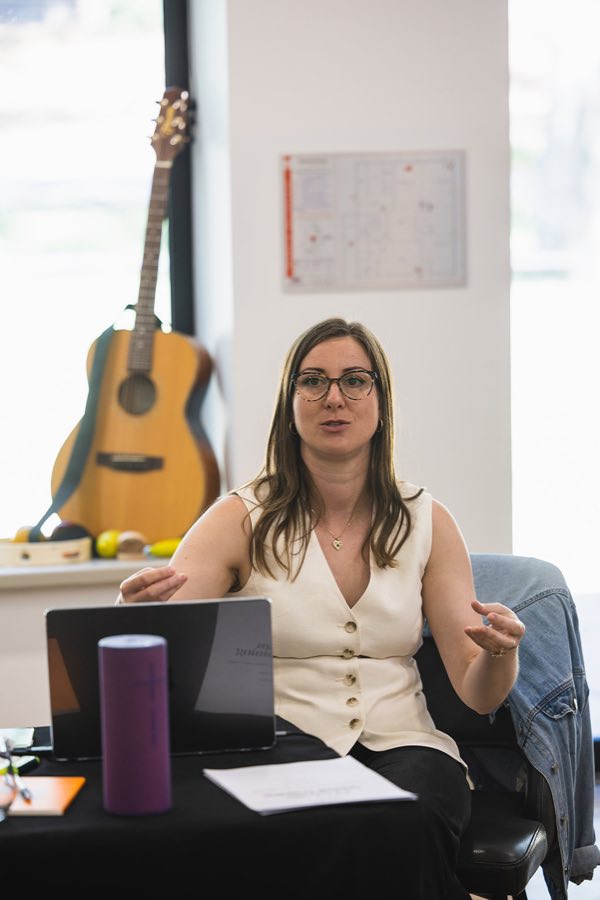
A Creative Therapy Adelaide team member sharing ideas during a team discussion
Reflecting together helps us consider whose goals we are working towards and how we describe support needs.

The words in a report matter, too

In our face-to-face interactions, we aim to be neuroaffirming. The difficult territory can be writing a report, especially when we need to explain someone’s support needs clearly.

We don’t want to dismiss the challenges. But we also don’t want a report to read as though the person is a problem to fix.

Our team looked at a sample paragraph about social communication. One phrase was that the person needed to “interact appropriately with peers”. What does appropriately actually mean?

One suggestion was to replace “appropriately” with “comfortably”. Another was to focus on the support the person requires, rather than starting with a list of difficulties.

But even saying a goal will improve someone’s quality of life can involve putting our own beliefs on it. For fictional John, one team member’s response brought us back to the starting point:

What would John like?

If John wants support to feel more comfortable communicating with peers, that gives us a direction. We shouldn’t assume that goal for him just because it seems important to us.

We can describe specific support needs and safety concerns clearly, without relying on a catch-all phrase such as “behaving appropriately”.

It’s an ongoing conversation

The people around someone might not have come across these ideas. How can we help families understand how we’re approaching our work? It might be little by little.

Those conversations need a strong relationship and trust. Families are often coming from a place of love and good intention. We can listen to their concerns while explaining why we’re making room for different ways of communicating.

Neuroaffirming practice isn’t just a list of replacement words. It’s being responsive, thinking about the context and continuing to question our assumptions.

Peer supervision gives us space to do that together. If we’re stuck on how to word something, we can tap the person next to us and ask whether they’ve got an idea. We’re here to keep learning from one another.

If you would like to discuss communication support for yourself or your child, explore our speech therapy services in Adelaide or contact our team. You don’t need to have everything figured out before getting in touch.

Adapted from a Creative Therapy Adelaide team discussion, with light editing for clarity. This article provides general information rather than individual advice. John is fictional and his examples are illustrative.

Related Articles

Start an Enquiry

Ready to explore further?

Tell us a little about support you're seeking.

Our team will review your enquiry and contact you to discuss suitable options and what the next step could look like.

You do not need to know exactly which therapist, location or funding pathway is right before contacting us.

Sending an enquiry does not commit you to access services.

Please avoid including sensitive health information in this initial message.

Prefer to speak with someone?

You can also contact our administration team during business hours.