NDIS Speech Pathology in Adelaide
Research-informed, strengths-based and family-centred speech pathology aligned with each participant’s communication needs and NDIS goals.
Not sure where to start? Tell us what you know and our team will help guide the next step.

Speech Pathology and the NDIS
Speech pathology is an allied health profession that supports people of all ages with speech, language and communication needs. Speech pathologists assess each person’s communication strengths and needs, develop individualised goals, and provide evidence-based support to increase participation in everyday life.
The NDIS may fund speech pathology when the support relates to an eligible participant’s disability, goals and funded supports.
If you are considering therapy at your child’s school or preschool, our guide to NDIS therapy at school and preschool in Adelaide explains school approval, funding, scheduling, communication and how to get started.
Creative Therapy Adelaide is an NDIS-registered provider supporting self-managed, plan-managed and NDIA-managed participants. We provide clinic-based speech pathology in Torrensville, community visits across metropolitan Adelaide and telehealth appointments.
If you or your child are new to the NDIS, you may have questions about what can be funded or what therapy involves. We have brought together the key information you need to understand and access NDIS speech pathology services in Adelaide.

Creative Therapy Adelaide supports self-managed, plan-managed and NDIA-managed participants.
Who is eligible for NDIS-funded speech pathology?
Every NDIS plan is different and is based on the participant’s individual needs, disability-related support requirements and goals.
Speech pathology may be funded when a participant’s communication needs relate to their disability and the support helps them work towards goals such as communicating more independently, developing everyday skills or participating in their community.
Having an NDIS plan does not automatically mean every service will be funded. Check that your plan includes relevant therapy supports and that speech pathology aligns with your funded supports and goals. You can learn more in the NDIS guide to using your funding .

When might NDIS speech pathology be appropriate?
NDIS-funded speech pathology may be appropriate when a participant’s communication needs relate to their disability and the support aligns with their NDIS goals and funded supports.
A child has a developmental delay affecting their speech, language or communication.
A person has an ongoing disability that affects their ability to understand others, express themselves or participate socially.
Communication support is required in relation to autism, cerebral palsy, intellectual disability, stroke, brain injury, Parkinson’s disease or dementia.
Support is needed to develop functional communication skills or use augmentative and alternative communication (AAC).
Every NDIS plan is different. Funding depends on the participant’s individual circumstances, goals and included supports.
How funding works
Your NDIS plan can be managed in three ways: self-managed, plan-managed, and NDIA-managed.
Upon receiving your plan, remember to check what support categories are included in your plan. Speech pathology services are usually funded under:
Self-managed
You have control over how you want to use your funds and manage your supports. With speech pathology, this means you have the choice to engage with both unregistered and registered speech pathologists.
Plan-managed
A plan manager will support you in processing invoices and managing payments. NDIS has a tool to help you find plan management providers.
NDIA-managed
NDIA will manage your funds for you but you will still get to select from a range of NDIS-registered providers, or NDIS-registered speech pathologists in this case.
Capacity building – improved daily living
(including early intervention supports for early childhood, that is, participants under 9 years old)
Finally, do ensure that speech pathology is aligned with your NDIS goals. NDIS can fund your speech pathology services as long as it helps you pursue your plan goals and is beneficial in supporting your disability.
What does NDIS speech pathology typically involve?
NDIS speech pathology sessions usually involve a combination of assessment, therapy, and collaboration with families and caregivers.
Initial sessions
During the first few sessions, the speech pathologist would want to spend time getting to know you or your child. This would involve playing ice-breakers and language-based games, and having conversations about your interests, school/work, daily routine etc.
The initial sessions would also most likely involve some assessment (informal or formal) to help us begin formulating therapy goals. For example, if your child had a referral for difficulties being understood or having unclear speech, we might get your child to imitate words or label pictures so that we can take note of difficulties with specific speech sounds.
We would also want to talk about what therapy goals you want for yourself or your child. These can include the broader NDIS goals and more specific speech or language goals. We do this to ensure that our time in therapy is spent meaningfully.
Regular therapy sessions
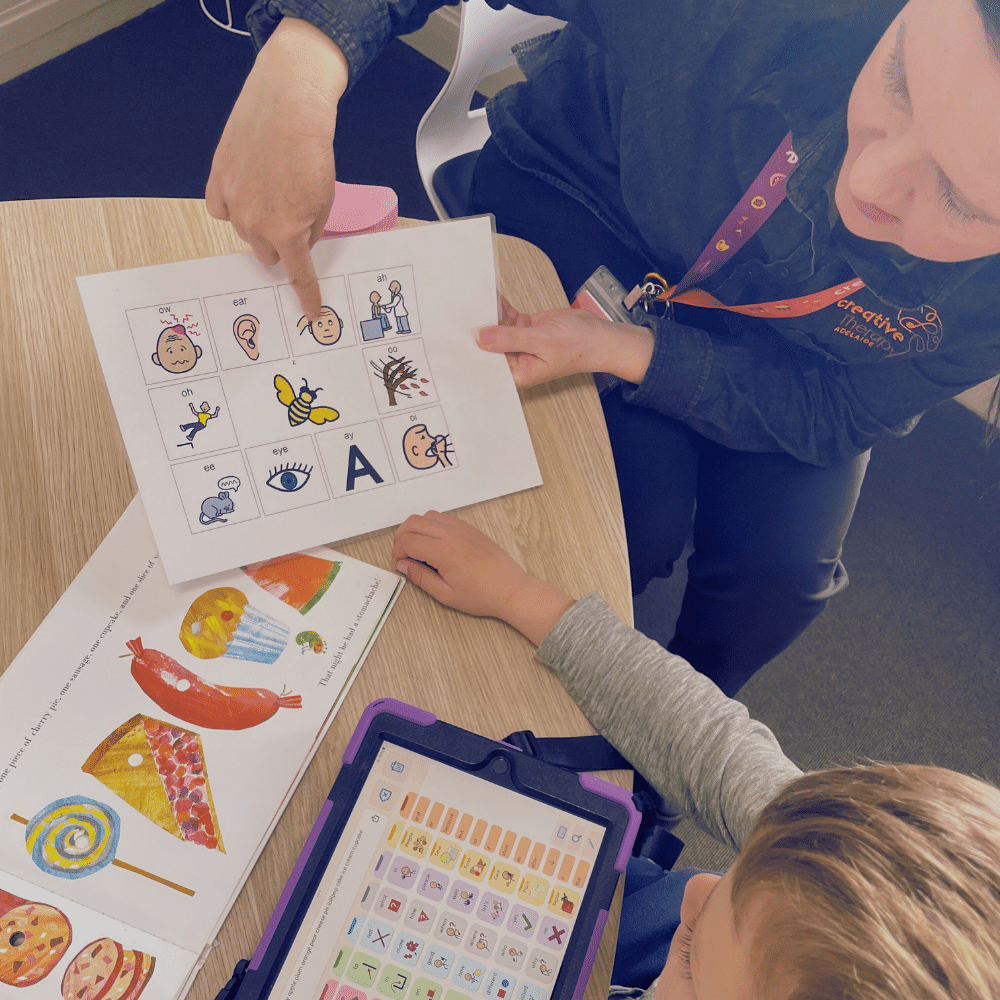
Therapy sessions can be individual or in small groups, and they often include a variety of activities we think would be most effective for each person. These may look like turn-taking games or role playing to teach social communication, speech activities to target speech sounds, or practising using AAC device.
Sessions also involve working closely with parents or caregivers. Often, speech pathologists will share take-home strategies to support your communication day-to-day. This will help skills generalise beyond therapy sessions.

Creative Therapy Team
Our approach at Creative Therapy Adelaide
Creative Therapy Adelaide is an NDIS-registered provider.
We provide clinic-based and community-based speech pathology services for participants of all ages across Adelaide.
Evidence-based
NDIS-registered providers are required to deliver evidence-based therapy support. At Creative Therapy Adelaide, the speech pathology team stays up to date with the latest research in therapy approaches to ensure that we are providing the right support for our participants.
Collaboration with families
We value working collaboratively with families because we believe it makes a huge difference in therapy progress. We want families to feel seen and supported throughout therapy just as much as we want participants to feel the same way.
Individualised goals
Therapy is meaningful when goals are functional and relevant to your daily life. In collaboration with families and the participants themselves, we plan individualised therapy goals that aim to support communication and community participation beyond the clinic.
Music integration
For some participants, music can increase motivation and support regulation, and even create opportunities for communication. Where appropriate, we integrate music into therapy sessions if we think it can make therapy more engaging and meaningful for our participants. Learning from our Registered Music Therapist colleagues gives us insight into effectively weaving music into our sessions!
How do I get started?
Fill in our contact form below to get started.
Start an enquiry
Share your details and what you are looking for.
We review your request
Our team reviews the information and considers the right starting point.
Plan the right starting point
We discuss the program format, funding and delivery option that suit your needs.
Ready to get started straight away? Complete our Intake Form instead.
Frequently asked questions
We know that understanding NDIS funding and choosing the right support can feel complicated. Here are answers to some common questions.
Do I need a referral for NDIS speech pathology?
No. You do not usually need a referral to access speech pathology through the NDIS. What matters is that the support relates to the participant’s disability-related needs, NDIS goals and available funding.
If you are unsure, your support coordinator, NDIS contact or early childhood partner may be able to help you understand whether speech pathology is appropriate within your plan.
Do you accept plan-managed and self-managed participants?
Yes. We support participants who are plan-managed and self-managed. We can also support NDIA-managed participants because Creative Therapy Adelaide is an NDIS-registered provider.
If you are unsure how your funding is managed, contact us and we can help you understand what information we need before getting started.
How do I know whether my NDIS plan can fund speech pathology?
Every NDIS plan is different. Speech pathology may be funded when it relates to the participant’s disability-related needs, goals and included supports. It may appear within Capacity Building supports, such as Improved Daily Living, depending on the individual plan.
Your plan manager, support coordinator or NDIS contact can help you confirm how your funding may be used. Our team can explain our services and provide the information you may need, but we cannot approve or guarantee NDIS funding.
Where are speech pathology sessions available?
We offer clinic-based appointments at our Torrensville location, community visits across metropolitan Adelaide and telehealth appointments where appropriate.
Contact us to discuss which option may be suitable for your needs, goals and location.
What if I am not sure whether speech pathology is the right support?
You do not need to have everything figured out before contacting us. Tell us about the communication challenges you or your child are experiencing, and our team can help you understand whether our speech pathology service may be a suitable starting point.
If another service appears more appropriate, we will be honest about that and help guide you towards the next step where possible.
Can parents or caregivers be involved in speech pathology sessions?
Yes. Sessions can involve working closely with parents or caregivers. Speech pathologists may share take-home strategies to support communication day-to-day and help skills generalise beyond therapy sessions.
Ready to explore further?
Tell us a little about support you're seeking.
Our team will review your enquiry and contact you to discuss suitable options and what the next step could look like.
You do not need to know exactly which therapist, location or funding pathway is right before contacting us.
Sending an enquiry does not commit you to access services.
Please avoid including sensitive health information in this initial message.
You can also contact our administration team during business hours.